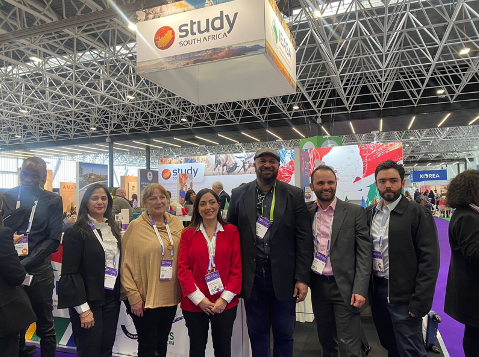
In a groundbreaking move, the University of the Free State (UFS) Qwaqwa Campus has solidified its commitment to internationalisation through a successful exchange programme with the Freiburg University of Education in Germany. This partnership, formalised by a Memorandum of Understanding (MoU), has opened doors for students, staff, and faculty members to engage in enriching academic and cultural exchanges.
One of the early beneficiaries of this collaboration is Sanelisiwe Khumalo, a master’s student from the Department of Sociology in the Faculty of the Humanities. For four months, Khumalo embarked on a life-changing journey to Freiburg, Germany, where she immersed herself in the vibrant academic and cultural landscape.
During her time in Germany, Khumalo not only excelled academically, but also embraced the opportunity to explore the country’s rich cultural heritage. She participated in various activities, including hiking in the Black Forest, visiting historical cities such as Frankfurt and Stuttgart, and attending cultural events.
Group photo of Sanelisiwe Khumalo making connections across continents, with her partners in education. A global classroom at Freiburg
One particularly memorable experience was her encounter with other Africans during an artistic intervention by Thabo Thindi. This event provided a powerful platform for reflection and cultural exchange, fostering a sense of belonging and connection.
Insightful, thought-provoking, and inspiring: These were some of the words used to describe the 2024 Global Social Innovation Indaba, which took place at the Centenary Complex on the University of the Free State’s (UFS’s) Bloemfontein Campus from 30 September to 2 October 2024. The three-day conference was hosted by the global Social Innovation Exchange (SIX) in collaboration with the UFS, under the theme ‘People Powered Change’. The conference brought together leaders and innovators from South Africa and several other countries, including Louise Pulford, CEO of SIX; Markus Lux, Senior Vice-President at Robert Bosch Stiftung, and Desmond D’Sa from the South Durban Community Environment Alliance (SDCEA), among others.
The last day featured a panel discussion titled ‘Challenging power dynamics and redefining global exchange’, which included an engagement session with the audience. Guests were able to reflect on the information they had acquired at the conference and challenged themselves to continue working towards change and innovation.
“What I learnt from these three days is that since we all want to do the right thing, we all know what the job that needs to be done is,” said Michael Ngigi, CEO of Thinkplace Africa. “As such, we need to be bold in going for that, and really push back on the status quo that is formed by the places we represent”.
The University of the Free State (UFS) continues to advance its global academic collaborations, as evidenced by the recent keynote address delivered by Prof Hussein Solomon at the prestigious International Young Scholars Conference at Jawaharlal Nehru University on 3 October 2024. In addition to his keynote, Professor Solomon presented a thought-provoking lecture titled “India’s Contribution in Ensuring Africa’s Security” at Jamia Millia Islamia on 4 October 2024, highlighting India’s significant role in the African security landscape.
A notable outcome of this visit is the pending finalisation of a Memorandum of Understanding (MoU) with Delhi University. This agreement aims to expand the current partnership with Jawaharlal Nehru University from a faculty-level agreement to a comprehensive, institution-wide collaboration across multiple disciplines beyond the humanities. This development will facilitate joint research initiatives, collaborative PhD supervision, and joint funding proposals, marking a significant step forward for both institutions.
Prof Solomon’s academic contributions extend beyond administrative agreements. He is co-editing a forthcoming book on BRICS and climate change with Prof Bashabi Gupta from the Department of Geography at Delhi University. This work aligns with the upcoming BRICS Summit in Kazan, Russia, later this month. Moreover, plans are underway for a second volume, as well as a new book focused on feminist decoloniality from African and Asian perspectives, which seeks to amplify marginalised voices in global scholarship. Read more…
Date: 04 October 2024
Author: Dr Nitha Ramnath
Photo: Supplied
https://ieasa.studysa.org/wp-content/uploads/2022/04/Logo.png00rochi-adminhttps://ieasa.studysa.org/wp-content/uploads/2022/04/Logo.pngrochi-admin2024-12-04 14:08:262024-12-04 14:20:24UFS’ Prof Hussein Solomon fosters cross-cultural dialogue in India
The Amrut Foundation, in partnership with the University of the Free State (UFS), successfully hosted its Inaugural Innovathon at the UFS Qwaqwa Campus. This competition is designed to identify and support innovative products and services that not only generate profit but also contribute to the public good, with a strong emphasis on ethical business practices. Through this collaboration, students gain national exposure for their businesses and receive support to create sustainable social enterprises.
Hemang Desai, Executive Director of the Amrut Foundation, expressed his enthusiasm for the event: “Amrut is proud to co-host the Free State leg of the inaugural Innovation Challenge with the UFS. Supporting students with entrepreneurial ambitions that align with societal care is one of our key focus areas.”
Five teams of student social entrepreneurs from the Qwaqwa campus were shortlisted to participate in the regional finals. Their selection was based on ventures that adhered to a social entrepreneurship model and demonstrated plans for long-term profitability and sustainability. Read more…
Date: 03 October 2024
Author: Ansie Barnard
Photo: Supplied
https://ieasa.studysa.org/wp-content/uploads/2022/04/Logo.png00rochi-adminhttps://ieasa.studysa.org/wp-content/uploads/2022/04/Logo.pngrochi-admin2024-12-04 14:04:192024-12-04 14:07:46Amrut Foundation hosts Inaugural Innovathon at UFS
On 11 July 2024, Dr Samia Chasi, IEASA, co-presented a webinar titled “Coloniality in Virtual Exchange – Voices from South Africa” with Dr Divinia Jithoo, Durban University of Technology (DUT). Following previous editions presenting voices from Palestine & Lebanon and Brazil, this webinar was the final episode in a three-part research webinar series hosted by UNICollaboration with a focus on identifying and interrogating coloniality in virtual exchange (VE). The speakers addressed coloniality in the South African higher education context and reflected on its implications for VE practices. They also discussed the relevance and importance of decolonial approaches for critical VE research and practice.
UNICollaboration is a cross-disciplinary professional organisation committed to promoting the development and integration of VE across all disciplines and interest areas in formal and non-formal educational settings. For more information, go to https://www.unicollaboration.org.
https://ieasa.studysa.org/wp-content/uploads/2022/04/Logo.png00rochi-adminhttps://ieasa.studysa.org/wp-content/uploads/2022/04/Logo.pngrochi-admin2024-10-01 15:18:032024-10-01 15:18:05UniCollaboration Webinar by IEASA and DUT
IEASA has partnered with the Colombian Network for Internationalisation (RCI) to develop and implement an exciting new South African – Colombian internationalisation initiative, the GLOSOUTH project.
GLOSOUTH flyer Photo credit: IEASA and RCI
GLOSOUTH is collaborative initiative that focusses on advancing internationalisation of higher education in South Africa and Colombia. It gives expression to IEASA’s strategic priorities to strengthen and deepen working relations with sister organisations around the globe and to facilitate South-South collaboration. It is an ambitious, one-year project, supported by funding from the Colombian government via ICETEX. Project activities, which will be implemented between October 2024 and July 2025, include webinars, peer-to-peer networking sessions, a South African mission to Colombia as well as the development of a roadmap and a Massive Open Online Course (MOOC) on South Africa – Colombia collaboration.
Participants of the GLOSOUTH kick-off event at the 2024 EAIE Conference Photo credit: IEASA/Tohiera Bagus
After having recently been kicked off at the Study South Africa Booth during the 2024 Conference & Exhibition of the European Association for International Education (EAIE), the GLOSOUTH webinar series starts on 3 October 2024 with a session focussing on “Approaches to Internationalisation of Higher Education in Colombia and South Africa”.
https://ieasa.studysa.org/wp-content/uploads/2022/04/Logo.png00rochi-adminhttps://ieasa.studysa.org/wp-content/uploads/2022/04/Logo.pngrochi-admin2024-10-01 15:14:352024-10-01 15:16:16GLOSOUTH: Colombia – South Africa Initiative
In 2021 IEASA partnered with the British Council to jointly commission the first-ever national research study on internationalisation of higher education in South Africa, and the report on this study, titled “Exploring Internationalisation of Higher Education at Public Universities in South Africa: Intentions, Practices, Opportunities and Constraints”, was recently launched as part of programme of the 2024 IEASA Conference.
During a plenary session on 22 August 2024, Prof Felix Maringe, the research team lead, shared insights into the report, which explored the internationalisation endeavours of the 19 South African universities that participated in the research project. Representatives of two key stakeholders – Dr Idah Makukule on behalf of the Department of Higher Education and Training (DHET) and Dr Phetiwe Matutu on behalf of Universities South Africa (USAf) – offered their responses on the report before Dr Lavern Samuels, IEASA President, and George Barrett, British Council South Africa Country Director, shared their reflections on the research project as representatives of its commissioning parties. For more information on the plenary contributions, please see this article published in the UWN: https://www.universityworldnews.com/post.php?story=20240821205829761.
Participants of the report launch plenary at the 2024 IEASA Conference Photo credit: IEASA/Chris Allen
The research report is expected to play a significant role in assisting South African universities and other higher education stakeholders in implementing the DHET’s Policy Framework for Internationalisation of Higher Education in South Africa. As a baseline report, it provides a valuable resource that will inform the planning of future actions in support of internationalisation in South Africa, including future research.
Following the launch event, Dr Samia Chasi was invited to share findings from the report with members of USAf’s Research and Innovation Strategy Group (RISG) in an online meeting held on 12 September 2024.
https://ieasa.studysa.org/wp-content/uploads/2022/04/Logo.png00rochi-adminhttps://ieasa.studysa.org/wp-content/uploads/2022/04/Logo.pngrochi-admin2024-10-01 15:07:412024-10-01 15:09:22IEASA-British Council Internationalisation Research Project – Report Launch
University of KwaZulu-Natal’s (UKZN) much-anticipated Phoenix hybrid rocket test flight at the world-class Denel Overberg Test Range in the Western Cape has been a resounding success.
The successful flight took place on 8 March when a gap in the weather provided suitable launch conditions. The Phoenix-1B Mk IIr vehicle soared to a new high altitude mark for hybrid rockets, beating the previous African record of 10.3 km.
more ‘The team is delighted to see all of their hard work come to fruition with a picture-perfect flight, which exceed our expectations’ said Dr Jean Pitot, the leader of UKZN’s Aerospace Systems Research Group (ASReG).
ASReG’s Phoenix Hybrid Rocket Programme is a skills development initiative that focuses on suborbital launch vehicle design and testing.
‘Internationally, sounding rockets continue to play a crucial role in the facilitation of experiments conducted in a wide variety of scientific disciplines, including bio-technology, astronomy, astrophysics, materials science and meteorology, among many others,’ explained academic leader for mechanical engineering at UKZN, Professor Michael Brooks. ‘They also serve as valuable test platforms for aerospace technologies related to commercial satellite launch vehicles.’
The Phoenix-Mk IIr suborbital rocket that was successfully tested was developed as a technology demonstration platform.
After signing the fins pre-launch – a tradition in rocketry research – the team retreated to a mission control blockhouse from where the nerve-wracking countdown was initiated.
At 16h47 Mk IIr blasted off – and the exultant team broke into cheers as the rocket reached a 17.9 km altitude, setting the new African record.
Said Pitot: ‘The Mk IIr rocket is a high-performance version of our initial Mk I rocket, and demonstrates low-cost and robust construction methodologies coupled with advanced fabrication and propellant technologies.’
Brooks acknowledged the substantial funding received from the Department of Science and Innovation (DSI) for the project.
‘This funding has enabled the development of key expertise in the engineering disciplines of rocket propulsion technology, launch vehicle design and flight dynamics modelling, as well as the development of appreciable scarce skills. It has also enabled unique cooperation between the University and industry,’ he said.
The ASReG team included 18 postgraduate and undergraduate students who contributed to the success of the launch through their innovative research. These students are products of ASReG’s DSI-funded transformation-centred talent pipeline programme.
Lead engineer on the Phoenix campaign was UKZN PhD student, Mr Kai Broughton, a former winner of the prestigious Engineering Council of South Africa (ECSA) merit medal and a cum laude UKZNMSc Mechanical Engineering graduate who has been named among the African Space Industry’s Top 10 Under 30’s by the Space in Africa news agency.
Dean and Head of UKZN’s School of Engineering, Professor Glen Bright said: ‘This launch constitutes a deliverable on our DSI Space Propulsion Programme funding grant, under the category of technology demonstration. We are thrilled at the outcome and are very proud of our students whose meticulous work, dedication and commitment contributed to this success.’
The Chief Director of Space Science and Technology in the DSI, Mr Humbulani Mudau said: ‘Excellent work, team ASReG! You have broken the African record. The DSI on behalf of government is very proud of this achievement. Well done!’
Deputy Vice-Chancellor and Head of UKZN’s College of Agriculture, Engineering and Science, Professor Albert Modi echoed his sentiments: ‘Well done Guys! You have put UKZN on the map, we are so proud.’
A delighted and relieved Pitot said: ‘This launch is the culmination of months of preparation. We had to move an entire rocket team, its launch platform, two rockets, multiple back-up parts, computer equipment and everything that goes with it 1 700 km across the country. It was a massive undertaking, but the work has paid off.’
UKZN’s Aerospace Systems Research Group with a Phoenix-1B Mk I hybrid rocket.
The record-beating Phoenix-1B Mk IIr hybrid rocket leaves it’s launch rail at Denel Overberg Test Range.
https://ieasa.studysa.org/wp-content/uploads/2021/04/ukzn-2.jpg254451rochi-adminhttps://ieasa.studysa.org/wp-content/uploads/2022/04/Logo.pngrochi-admin2021-04-08 11:05:362021-04-13 10:14:29UKZN Students Smash African Hybrid Rocket Altitude Record
We may request cookies to be set on your device. We use cookies to let us know when you visit our websites, how you interact with us, to enrich your user experience, and to customize your relationship with our website.
Click on the different category headings to find out more. You can also change some of your preferences. Note that blocking some types of cookies may impact your experience on our websites and the services we are able to offer.
Essential Website Cookies
These cookies are strictly necessary to provide you with services available through our website and to use some of its features.
Because these cookies are strictly necessary to deliver the website, refusing them will have impact how our site functions. You always can block or delete cookies by changing your browser settings and force blocking all cookies on this website. But this will always prompt you to accept/refuse cookies when revisiting our site.
We fully respect if you want to refuse cookies but to avoid asking you again and again kindly allow us to store a cookie for that. You are free to opt out any time or opt in for other cookies to get a better experience. If you refuse cookies we will remove all set cookies in our domain.
We provide you with a list of stored cookies on your computer in our domain so you can check what we stored. Due to security reasons we are not able to show or modify cookies from other domains. You can check these in your browser security settings.
Other external services
We also use different external services like Google Webfonts, Google Maps, and external Video providers. Since these providers may collect personal data like your IP address we allow you to block them here. Please be aware that this might heavily reduce the functionality and appearance of our site. Changes will take effect once you reload the page.
Google Webfont Settings:
Google Map Settings:
Google reCaptcha Settings:
Vimeo and Youtube video embeds:
Privacy Policy
You can read about our cookies and privacy settings in detail on our Privacy Policy Page.